
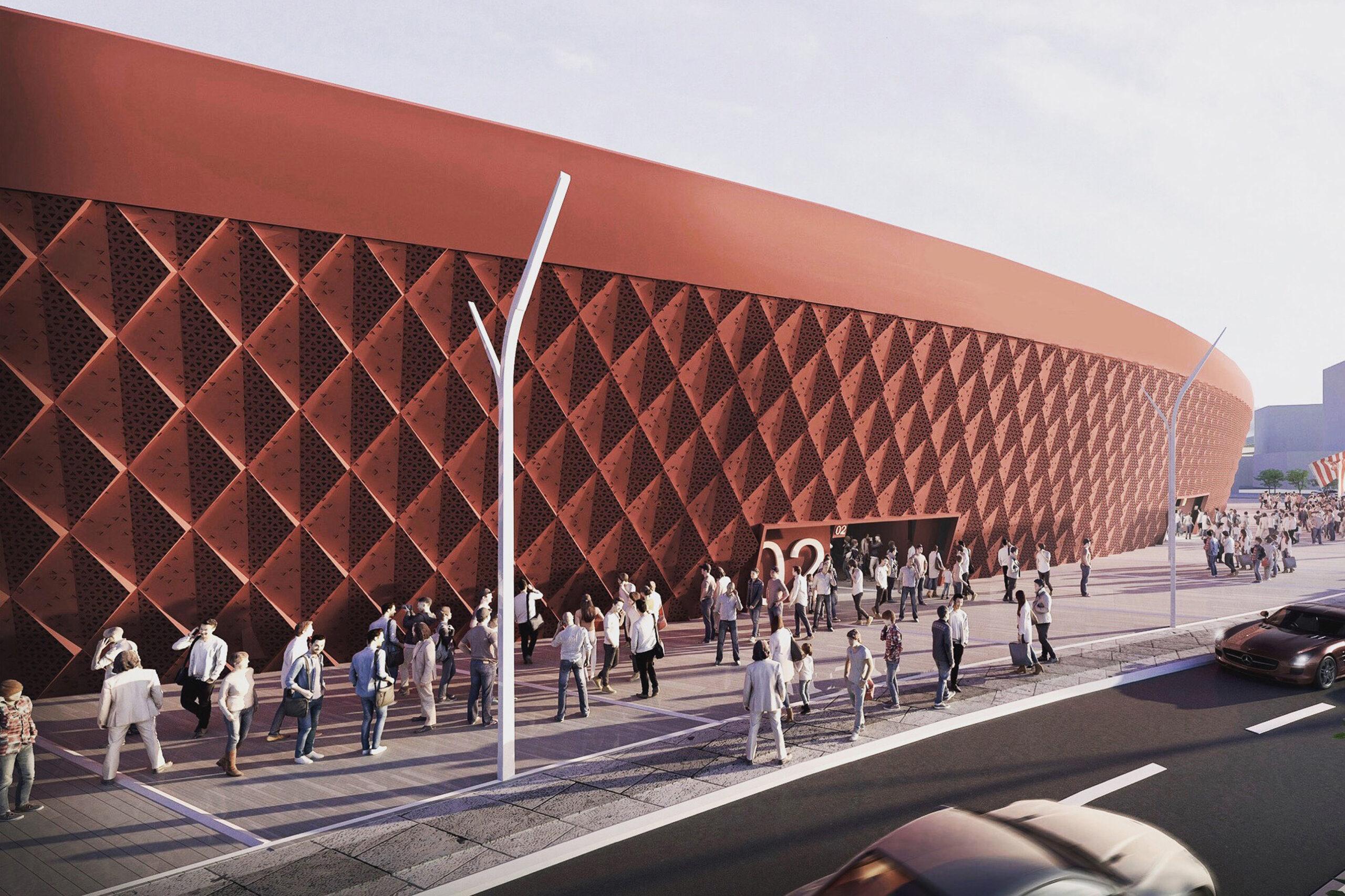
RECONSTRUCTION OF THE "RAJKO MITIC" STADIUM WITH PRESERVATION OF THE ATHLETICS TRACK - Honorable Mention
Belgrade, Serbia
Architecture urban solution of the reconstruction of “Rajko Mitic” stadium and its immediate surroundings
Announcer/Orderer of the competition: Sports association Red Star Footbal club (F.K. Crvena Zvezda)
External collaborators: construction – prof.dr. Mihajlo Samardžić, arch., 3d visualization – Aleksandar Čvorović, m. arch., Miloš Kolarić, m. arch., axonometry – Jovana Bugarski, m. arch.
Year: 2019.
The idea of reconstructing the existing stadium is to create an impressive structure that would dominate and be clearly visible. The unique colored facade, which clearly identifies the stadium, consists of a series of repeating geometric elements made of perforated aluminum that allow the flow of light and air and together form a single monolithic structure. Also, this perforated facade membrane allows for the formation of a specific nighttime image of the stadium when light from the interior emerges from it. The unification of all contents with a uniform and recognizable facade also affects the visibility of movement throughout the entire complex with clearly indicated and marked entrances.
The advantage of the already positioned stadium, mostly below ground, is that the facade in contact with users does not appear too high. The basic structural system of the reconstructed stadium is a combination of reinforced concrete and steel construction. The interfloor ceilings, stands and console auditorium are reinforced concrete structures, while the roof structure is steel. The building is founded on a foundation slab. The distance between the vertical structural elements is 9m. The console auditorium in the gallery is, in a constructive sense a support with an overhang. The console overhang of the gallery and the field on the part of the console overhang rests on the central reinforced concrete columns, while the other end of the field towards the street facade is attached to the roof structure with tightens. The roof structure is conceived as a spatial double steel support with a console overhang of 35-58m, depending on the geometric characteristics of the auditorium covering. The console overhang rests on the central column via “V” arms.
The central and facade columns are steel box profiles that are filled with reinforced concrete as fire protection and covered with fire-resistant materials. The console overhang is a combination of double supports (lower and upper part) which branch towards the central pillar so that the cross-section at the beginning of the console has a height of 30-50 cm and at the central pillar-support approximately 6 m. The upper and lower part of the console overhang are connected to each other with the infill made of steel box profiles (Vierendeel truss). The field of the console overhang is made according to the same principle as the console overhang with a height difference between the support in the field of 50 cm and the support on the central pillar approximately 6 m.
The negative reaction in the field of the console support is reduced by a system of tensioners that are fixed to the steel support, and the tensioners are also a support for the reinforced concrete construction of the gallery field. A central steel column runs from the gallery level to the roof with a “V” arm connecting the twin console parts (upper and lower parts). The distance between the primary steel structural elements is from 4 to 9 m. The upper part of the console is interconnected with stiffening couplings. The upper part of the roof is tensioned and the lower part is pressed and stiffened by a system of triangular space bars.
The roof covering is made of sandwich-sheet panels (with sound insulation and coatings on the underside against condensation) and rests on spatial steel triangular pipe grids (range 4 to 9m) at a mutual distance of 3m. The roof covering has a slope towards the external facades of the stadium, as does the roof truss, and water is drained into the storm drain by a system of horizontal and vertical gutters.
The structural system is safe against the effects of gravity and horizontal loads (seismic level VIII of the MCS scale).
It is also possible to form a multi-purpose space for the needs of spectators and the club in several levels under the existing stands on the ground. This would take place according to the principle of construction “from roof to foundation”, which in technical and technological terms means that bored piles and reinforced concrete stands are constructed first, and then a multi-level multipurpose space from the ground floor downwards. The multi-purpose space under the stands can be built in several stages, with the fact that the stadium would be functionally usable immediately after the completion of piling and the external construction of the reinforced concrete stands.


